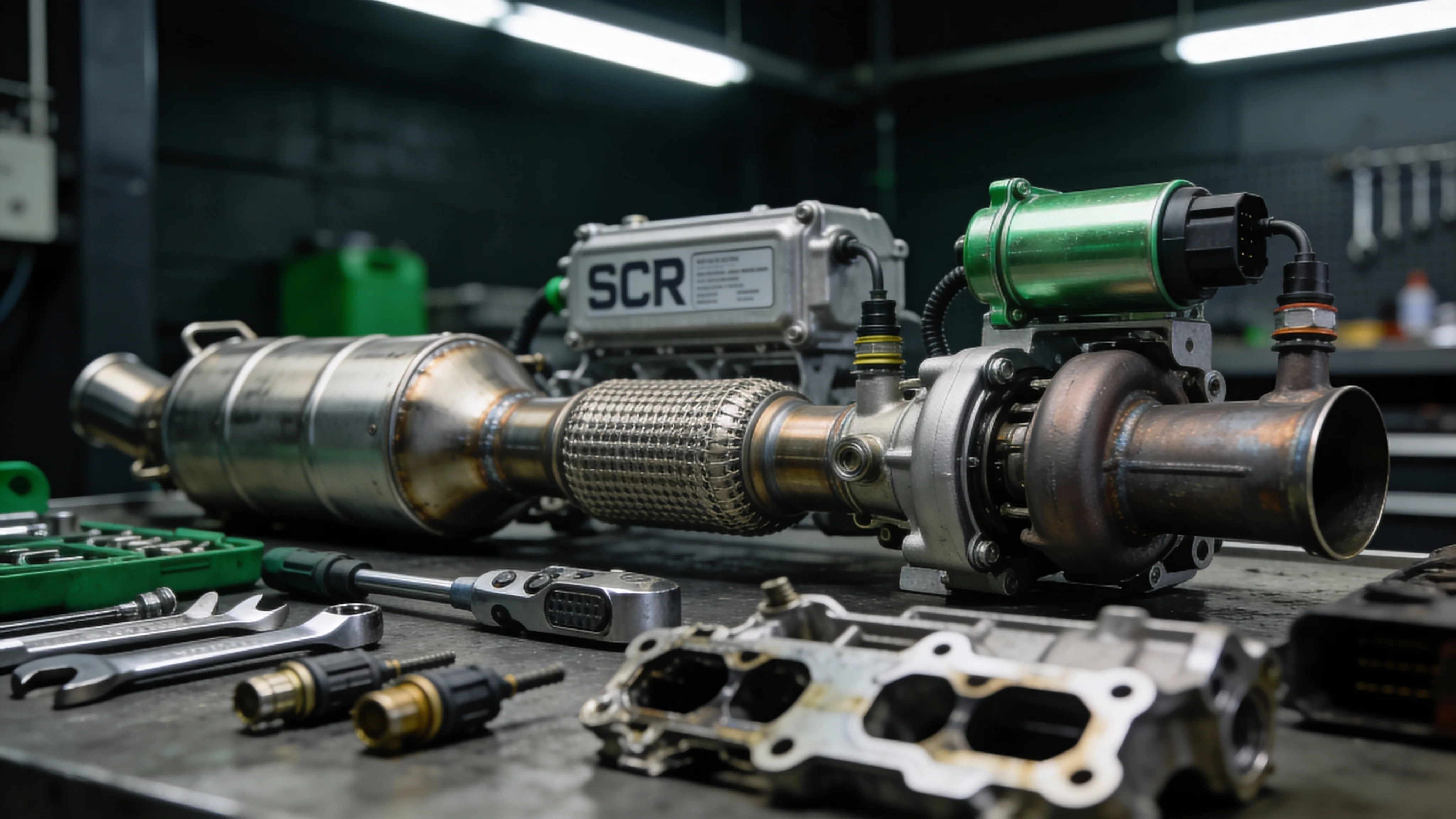
The AdBlue (SCR) system is key to diesel emissions control. Its most common faults, the symptoms they cause and how they affect the engine.
Introduction
.imported-article{ --bg: #06110B; --card: #12281A; --ink: #F5F7FA; --muted: #AEB8C2; --accent: #58CF0D; --accent-light: #7FE836; --accent-2: #7FE836; --line: #1C3624; --line-light: #16321F; --shadow: 0 4px 24px rgba(0,0,0,0.35); --shadow-lg: 0 12px 48px rgba(0,0,0,0.45); --radius: 12px; --radius-sm: 8px; } .imported-article *{ box-sizing: border-box; margin: 0; padding: 0; } .imported-article{ font-size: 16px; scroll-behavior: smooth; } .imported-article{ font-family: "Mona Sans", system-ui, sans-serif; color: var(--ink); background: var(--bg); line-height: 1.75; font-weight: 400; -webkit-font-smoothing: antialiased; -moz-osx-font-smoothing: grayscale; } .imported-article a{ color: var(--accent-2); text-decoration: none; transition: color 0.2s ease; } .imported-article a:hover{ color: var(--accent); text-decoration: underline; } .imported-article .container{ max-width: 800px; margin: 0 auto; padding: 40px 24px 80px; } .imported-article /* Header / Hero */ .hero{ background: linear-gradient(135deg, var(--card) 0%, var(--line-light) 100%); border: 1px solid var(--line); border-radius: var(--radius); padding: 40px 36px; margin-bottom: 32px; box-shadow: var(--shadow); } .imported-article .badge{ display: inline-flex; align-items: center; font-family: "Mona Sans", system-ui, sans-serif; font-size: 0.75rem; font-weight: 600; letter-spacing: 0.05em; text-transform: uppercase; color: var(--accent); background: rgba(88, 207, 13, 0.14); padding: 8px 14px; border-radius: 20px; margin-bottom: 20px; } .imported-article .meta{ display: flex; align-items: center; gap: 16px; font-family: "Mona Sans", system-ui, sans-serif; font-size: 0.875rem; color: var(--muted); margin-bottom: 16px; } .imported-article .meta-item{ display: flex; align-items: center; gap: 6px; } .imported-article h1{ font-family: "Mona Sans", system-ui, sans-serif; font-size: 2.25rem; font-weight: 900; line-height: 1.2; letter-spacing: -0.02em; color: var(--ink); margin-bottom: 16px; } .imported-article .subtitle{ font-size: 1.125rem; color: var(--muted); line-height: 1.6; max-width: 90%; } .imported-article /* Table of Contents */ .toc{ margin-top: 28px; padding: 24px; background: rgba(255,255,255,0.04); border: 1px solid var(--line); border-radius: var(--radius-sm); } .imported-article .toc-title{ font-family: "Mona Sans", system-ui, sans-serif; text-transform: uppercase; letter-spacing: 0.08em; font-size: 0.75rem; font-weight: 600; color: var(--accent); margin-bottom: 12px; } .imported-article .toc ul{ list-style: none; } .imported-article .toc li{ margin: 8px 0; font-family: "Mona Sans", system-ui, sans-serif; font-size: 0.9rem; } .imported-article .toc a{ color: var(--ink); } .imported-article .toc a:hover{ color: var(--accent); } .imported-article .toc .toc-sub{ margin-left: 20px; font-size: 0.85rem; color: var(--muted); } .imported-article /* Article Content */ .article{ background: var(--card); border-radius: var(--radius); border: 1px solid var(--line); padding: 48px 40px; box-shadow: var(--shadow); } .imported-article .article h2{ font-family: "Mona Sans", system-ui, sans-serif; font-size: 1.625rem; font-weight: 700; margin: 2.5rem 0 1rem; padding-top: 1.5rem; border-top: 1px solid var(--line-light); color: var(--ink); letter-spacing: -0.01em; } .imported-article .article h2:first-child{ margin-top: 0; padding-top: 0; border-top: none; } .imported-article .article h3{ font-family: "Mona Sans", system-ui, sans-serif; font-size: 1.25rem; font-weight: 700; margin: 1.75rem 0 0.75rem; color: var(--ink); } .imported-article .article p{ margin: 1rem 0; font-size: 1.0625rem; } .imported-article .article ul, .imported-article .article ol{ margin: 1rem 0 1.25rem 1.5rem; } .imported-article .article li{ margin: 0.5rem 0; font-size: 1.0625rem; } .imported-article .article li::marker{ color: var(--accent); } .imported-article .article strong{ font-weight: 600; color: var(--ink); } .imported-article .article hr{ border: none; height: 1px; background: var(--line-light); margin: 2rem 0; } .imported-article /* Tags */ .tags{ margin-top: 3rem; padding-top: 2rem; border-top: 1px solid var(--line); } .imported-article .tags h2{ font-family: "Mona Sans", system-ui, sans-serif; font-size: 0.875rem; font-weight: 600; text-transform: uppercase; letter-spacing: 0.05em; color: var(--muted); margin-bottom: 12px; border: none; padding: 0; } .imported-article .tag-list{ list-style: none; display: flex; flex-wrap: wrap; gap: 8px; } .imported-article .tag-list li{ font-family: "Mona Sans", system-ui, sans-serif; background: var(--line-light); border: 1px solid var(--line); border-radius: 20px; padding: 6px 14px; font-size: 0.8125rem; font-weight: 500; color: var(--muted); transition: all 0.2s ease; } .imported-article .tag-list li:hover{ background: rgba(88, 207, 13, 0.14); border-color: var(--accent); color: var(--accent); } .imported-article /* Footer */ .footer{ text-align: center; font-family: "Mona Sans", system-ui, sans-serif; color: var(--muted); font-size: 0.875rem; margin-top: 40px; padding-top: 24px; border-top: 1px solid var(--line); } .imported-article .footer a{ color: var(--accent); font-weight: 500; } .imported-article /* Responsive */ @media (max-width: 768px){ .container { padding: 24px 16px 60px; } .hero { padding: 28px 24px; } h1 { font-size: 1.75rem; } .article { padding: 32px 24px; } .article h2 { font-size: 1.375rem; } .article p, .article li { font-size: 1rem; } .meta { flex-wrap: wrap; gap: 10px; } } .imported-article /* Print styles */ @media print{ .toc, .tags, .badge, .footer { display: none; } .hero, .article { box-shadow: none; border: none; } body { font-size: 12pt; } } .imported-article .container{max-width:100%;padding:0;margin:0;}.meta{display:flex;flex-wrap:wrap;gap:8px 18px;align-items:center}.meta-item{display:inline-flex;gap:6px;align-items:center}.meta-item svg{width:16px;height:16px;flex:none} ReproRACE - Technical Guide By the ReproRACE Team 10 min read Contents What the AdBlue system is and what it does Why AdBlue system faults occur Most Common AdBlue System Faults 1\. NOx sensor failure 2\. AdBlue injector fault 3\. AdBlue pump problems 4\. AdBlue crystallization 5\. Faulty AdBlue quality or level sensor 6\. Electrical and communication faults How AdBlue faults affect the engine Limp mode activation Engine start lockout Increased fuel consumption Why an accurate AdBlue system diagnosis matters Preventing AdBlue system faults The relationship between AdBlue and engine management electronics How the ECU calculates AdBlue dosing Key sensors and their actual role Common error codes and what they mean Crystallization and problems caused by irregular use Common diagnostic errors Why clearing fault codes does not fix the problem Professional step-by-step diagnostics How the AdBlue system relates to other engine systems Real impact on performance and reliability Conclusion Introduction The AdBlue system , also known as SCR (Selective Catalytic Reduction) , is one of the fundamental pillars of emissions control in modern diesel engines. Its proper operation is essential to comply with current emissions regulations, especially in Euro 6 vehicles, trucks, agricultural machinery, and industrial equipment. When AdBlue system faults occur, the impact is not limited to emissions alone: they can cause power limitation , limp mode , persistent dashboard warnings, and even engine start lockout if not fixed in time. In this article, we take an in-depth look at the most common AdBlue system faults , why they occur, and how they affect overall engine operation. What the AdBlue system is and what it does The AdBlue system uses a 32.5% urea solution that is injected into the exhaust system. When it reacts with hot gases, it converts nitrogen oxides (NOx) into nitrogen and water vapor , significantly reducing pollutant emissions. This process is electronically controlled by the engine ECU and a dedicated SCR system control unit, which manages: AdBlue dosing System temperature NOx sensors Fluid pressure and quality The AdBlue system does not operate independently: it is fully integrated into the engine's electronic strategy . Why AdBlue system failures occur The AdBlue failures can have many causes, but in most cases they are related to: Sensors Fluid quality Electronic components Vehicle operating conditions As this is a sensitive and complex system, any deviation from the expected values can trigger faults recorded in the ECU. Most common AdBlue system failures Below, we detail the most common AdBlue system failures and their real impact on the engine. 1\. NOx sensor failure NOx sensors measure the amount of nitrogen oxides before and after the SCR catalyst. When one of these sensors fails: The ECU cannot verify the system's effectiveness Electronic errors are logged Limp mode is activated This is one of the most common failures and one of the ones that generates the most dashboard warnings. 2\. AdBlue injector failure The injector responsible for spraying AdBlue can become clogged or suffer an electrical failure. When this happens: Dosing is incorrect The system does not reduce NOx adequately Specific error codes appear A faulty injector can cause incorrect SCR system regenerations and increase AdBlue consumption. 3\. AdBlue pump problems The pump is responsible for supplying pressure to the system. The most common faults include: Electrical faults Pressure loss Internal blockages due to crystallization When the pump does not operate within the specified parameters, the ECU detects the fault and activates protection strategies. 4\. AdBlue crystallization Crystallization occurs when the fluid dries out or is exposed to extreme temperatures. This can affect: Pipes Injectors Sensors Pumps It is one of the most common causes of failure in cold climates or in vehicles used irregularly. 5\. Faulty AdBlue quality or level sensor If the system detects an incorrect level or quality reading: Persistent warnings are generated The system may limit operation The error cannot be cleared until the cause is resolved This type of fault is especially common in industrial and agricultural vehicles. 6\. Electrical and communication faults The AdBlue system depends on multiple electrical connections. Issues such as: Corroded connectors Damaged wires CAN communication errors can cause intermittent faults that are difficult to diagnose if not analyzed correctly. How AdBlue faults affect the engine Although the AdBlue system acts on the exhaust, its faults have direct consequences for engine operation. Limp mode activation One of the best-known effects is entering limp mode , where: Power is reduced Engine speed is limited The vehicle becomes less responsive This is done to ensure emissions compliance and protect the system. Engine start lockout In many modern vehicles, if the fault persists and is not corrected: A countdown is activated The engine may not start after being switched off This lockout is a legal measure required by anti-pollution regulations. Increased fuel consumption Incorrect dosing and correction strategies can lead to: Higher fuel consumption Higher AdBlue consumption Inefficient engine operation The importance of correctly diagnosing the AdBlue system A professional diagnosis must go beyond reading error codes. It is essential to analyze: Actual sensor values Pump operation Injector dosing Active ECU strategies Clearing errors without resolving the real cause does not fix the fault and may make the problem worse. Preventing AdBlue system faults Some key recommendations: Always use certified-quality AdBlue Avoid leaving the system unused for long periods Respond to electronic alerts from the outset Perform regular system checks Proper electronic management and adequate maintenance drastically reduce the likelihood of breakdowns. The relationship between AdBlue and electronic engine management The SCR system is part of a complex electronic strategy in which the ECU: Monitors emissions in real time Adjusts dosing according to load and temperature Activates safeguards when it detects anomalies That is why many AdBlue failures are directly related to other engine systems. How the ECU calculates AdBlue dosing The ECU does not inject AdBlue “by time,” but as needed. To do so, it uses a model based on: Engine load and exhaust gas flow . Exhaust temperature (without sufficient temperature, the reaction is not efficient). NOx readings before and after the SCR . Internal conversion maps that estimate how much urea is needed. If the upstream NOx sensor indicates high levels, the ECU increases the dosing. If the downstream sensor detects that conversion is insufficient, it adjusts the model or generates a DTC. This balance explains why a sensor failure can trigger a “dosing error” even when the injector is working correctly. Key sensors and their actual role The main sensors in the AdBlue system are: Upstream NOx sensor : measures actual emissions; it is the main reference. Downstream NOx sensor : validates SCR efficiency. Exhaust gas temperature sensor : determines whether the chemical reaction can take place. AdBlue level and quality sensor : prevents injection of degraded or insufficient fluid. System pressure sensor : verifies that the pump and circuit are operating within range. A failure in any of these components can produce similar symptoms: warning light, quality warning, reduced power, or a start countdown. That’s why diagnosis must be based on real data, not just the error code. Common error codes and what they mean Some common DTCs in SCR/AdBlue systems include: P20E8 : low system pressure. This may be due to the pump, leaks, or the pressure sensor. P204F : SCR system efficiency below threshold. This does not always indicate a catalytic converter failure; it may be a sensor. P207F : incorrect reductant quality. This is usually related to crystallization or degraded fluid. P2201 / P2202 : NOx sensor plausibility faults. The key is to interpret what the ECU detected: a pressure discrepancy, insufficient conversion, or an out-of-range signal. The DTC is the symptom, not the root cause. Crystallization and problems caused by irregular use AdBlue is sensitive to temperature and time. When the vehicle is used infrequently or repeatedly shut off during short cycles: The fluid can crystallize in the injector. The system’s narrow passages become blocked. The pump has to work harder. This causes intermittent faults that tend to come and go, and are often interpreted as a “faulty sensor.” However, the actual cause is the physical condition of the fluid and the lack of a stable exhaust temperature. Common diagnostic errors Replacing the injector without checking the actual pressure . If the pump cannot reach the required pressure, the injector is not the problem. Replacing NOx sensors without checking the wiring and ground . The fault may be in the power supply or a corroded connector. Interpreting a P204F as a damaged catalytic converter without checking the AdBlue temperature and quality. Clearing errors without checking live data . The system fails again because the model continues to detect inconsistencies. Why clearing errors does not fix the fault The SCR operates using a conversion model. If the ECU continues to detect that conversion is insufficient or that the dosing pressure is below the expected value, it will log the fault again. Clearing the DTC only removes the warning temporarily; it does not fix the underlying physics or control logic. Professional step-by-step diagnosis A technical diagnosis should include: Reading DTCs with freeze frame . Checking circuit pressure at different stages. Checking NOx and temperature sensors in real time. Actuator tests (pump, injector, heaters). Assessing the fluid condition and its consumption history. Only with this data can you determine whether the problem is with a sensor, the hydraulic system, or the actual efficiency of the SCR catalyst. How the AdBlue system relates to other engine systems The SCR does not operate in isolation. Its effectiveness depends on the condition of the engine and the systems that affect combustion: EGR : if it recirculates too much or operates outside its range, it changes exhaust gas temperature and NOx production, altering AdBlue demand. Injection : poor atomization can increase NOx and soot, forcing the SCR to operate outside its normal range. DPF : when the DPF becomes saturated, backpressure increases and the exhaust temperature profile changes, reducing the efficiency of the SCR catalyst. That is why a recurring AdBlue fault may be a symptom of a broader problem with the engine's electronic management. A lasting solution requires checking the entire system, not just the tank and injector. Real impact on performance and reliability When the AdBlue system develops a fault, the ECU typically applies protective strategies that go beyond a simple warning: Torque limitation to prevent emissions from exceeding regulatory limits. Limp mode with a sluggish throttle response. Engine start lockout in vehicles subject to strict regulations. These strategies are not optional; they are programmed to comply with legislation. Ignoring them or “overriding” the system is not only illegal, it can also create new inconsistencies in the ECU and increase the risk of failures in other systems. Conclusion The most common AdBlue system failures are not isolated faults, but the result of a highly integrated system that requires precise, professional diagnosis. Ignoring warnings or applying quick fixes without analysis can lead to severe vehicle restrictions. Understanding how the system works, which faults are common, and how they affect the engine is key to maintaining reliability, performance, and regulatory compliance. At ReproRACE, we approach AdBlue systems from a technical, preventive, and solution-oriented perspective , always analyzing the complete electronic strategy before taking action. This approach avoids unnecessary replacements and reduces vehicle downtime. It also helps preserve emissions logic within the manufacturer's original parameters. And it maintains consistency between sensors, internal models, and protection strategies. Tags particulate filter clogged DPF DPF regeneration DPF fault DPF cleaning engine electronics advanced diagnostics error code electronic fault specialist workshop Related ReproRACE services What to do if your AdBlue system fails Software-based AdBlue (SCR) deactivation Find your vehicle and check its power gains ReproRACE remapping workshops near you Stage 1 remapping Faults and fault codes ReproRACE — ReproRACE - engine electronics with technical expertise.