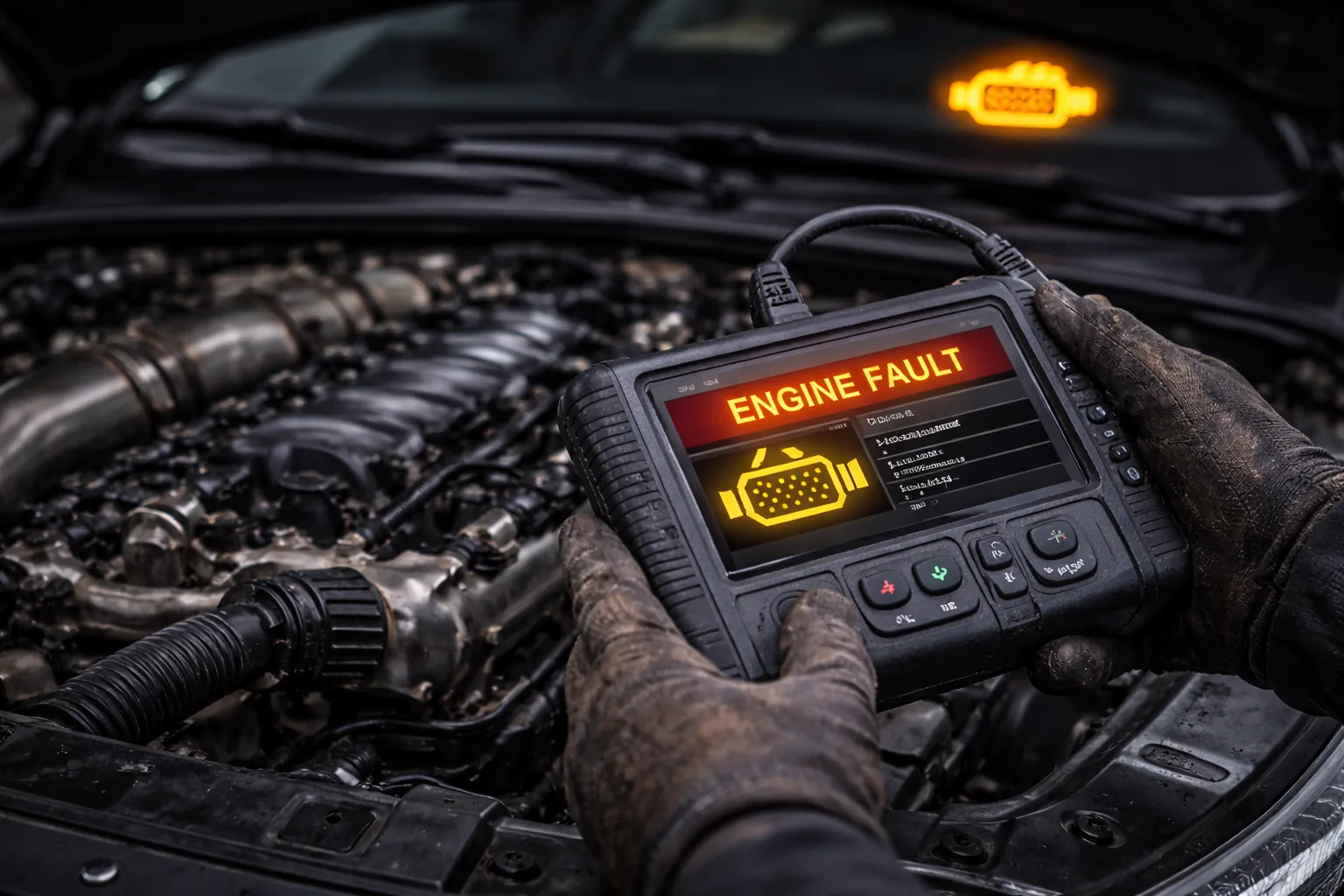
At ReproRACE we start from a clear axiom: sensors fail more often than actuators. This article explains how the ECU identifies inconsistencies, what tests…
Introduction
.imported-article{ --bg: #06110B; --card: #12281A; --ink: #F5F7FA; --muted: #AEB8C2; --accent: #58CF0D; --accent-light: #7FE836; --accent-2: #7FE836; --line: #1C3624; --line-light: #16321F; --shadow: 0 4px 24px rgba(0,0,0,0.35); --shadow-lg: 0 12px 48px rgba(0,0,0,0.45); --radius: 12px; --radius-sm: 8px; } .imported-article *{ box-sizing: border-box; margin: 0; padding: 0; } .imported-article{ font-size: 16px; scroll-behavior: smooth; } .imported-article{ font-family: "Mona Sans", system-ui, sans-serif; color: var(--ink); background: var(--bg); line-height: 1.75; font-weight: 400; -webkit-font-smoothing: antialiased; -moz-osx-font-smoothing: grayscale; } .imported-article a{ color: var(--accent-2); text-decoration: none; transition: color 0.2s ease; } .imported-article a:hover{ color: var(--accent); text-decoration: underline; } .imported-article .container{ max-width: 800px; margin: 0 auto; padding: 40px 24px 80px; } .imported-article /* Header / Hero */ .hero{ background: linear-gradient(135deg, var(--card) 0%, var(--line-light) 100%); border: 1px solid var(--line); border-radius: var(--radius); padding: 40px 36px; margin-bottom: 32px; box-shadow: var(--shadow); } .imported-article .badge{ display: inline-flex; align-items: center; font-family: "Mona Sans", system-ui, sans-serif; font-size: 0.75rem; font-weight: 600; letter-spacing: 0.05em; text-transform: uppercase; color: var(--accent); background: rgba(88, 207, 13, 0.14); padding: 8px 14px; border-radius: 20px; margin-bottom: 20px; } .imported-article .meta{ display: flex; align-items: center; gap: 16px; font-family: "Mona Sans", system-ui, sans-serif; font-size: 0.875rem; color: var(--muted); margin-bottom: 16px; } .imported-article .meta-item{ display: flex; align-items: center; gap: 6px; } .imported-article h1{ font-family: "Mona Sans", system-ui, sans-serif; font-size: 2.25rem; font-weight: 900; line-height: 1.2; letter-spacing: -0.02em; color: var(--ink); margin-bottom: 16px; } .imported-article .subtitle{ font-size: 1.125rem; color: var(--muted); line-height: 1.6; max-width: 90%; } .imported-article /* Table of Contents */ .toc{ margin-top: 28px; padding: 24px; background: rgba(255,255,255,0.04); border: 1px solid var(--line); border-radius: var(--radius-sm); } .imported-article .toc-title{ font-family: "Mona Sans", system-ui, sans-serif; text-transform: uppercase; letter-spacing: 0.08em; font-size: 0.75rem; font-weight: 600; color: var(--accent); margin-bottom: 12px; } .imported-article .toc ul{ list-style: none; } .imported-article .toc li{ margin: 8px 0; font-family: "Mona Sans", system-ui, sans-serif; font-size: 0.9rem; } .imported-article .toc a{ color: var(--ink); } .imported-article .toc a:hover{ color: var(--accent); } .imported-article .toc .toc-sub{ margin-left: 20px; font-size: 0.85rem; color: var(--muted); } .imported-article /* Article Content */ .article{ background: var(--card); border-radius: var(--radius); border: 1px solid var(--line); padding: 48px 40px; box-shadow: var(--shadow); } .imported-article .article h2{ font-family: "Mona Sans", system-ui, sans-serif; font-size: 1.625rem; font-weight: 700; margin: 2.5rem 0 1rem; padding-top: 1.5rem; border-top: 1px solid var(--line-light); color: var(--ink); letter-spacing: -0.01em; } .imported-article .article h2:first-child{ margin-top: 0; padding-top: 0; border-top: none; } .imported-article .article h3{ font-family: "Mona Sans", system-ui, sans-serif; font-size: 1.25rem; font-weight: 700; margin: 1.75rem 0 0.75rem; color: var(--ink); } .imported-article .article p{ margin: 1rem 0; font-size: 1.0625rem; } .imported-article .article ul, .imported-article .article ol{ margin: 1rem 0 1.25rem 1.5rem; } .imported-article .article li{ margin: 0.5rem 0; font-size: 1.0625rem; } .imported-article .article li::marker{ color: var(--accent); } .imported-article .article strong{ font-weight: 600; color: var(--ink); } .imported-article .article hr{ border: none; height: 1px; background: var(--line-light); margin: 2rem 0; } .imported-article /* Tags */ .tags{ margin-top: 3rem; padding-top: 2rem; border-top: 1px solid var(--line); } .imported-article .tags h2{ font-family: "Mona Sans", system-ui, sans-serif; font-size: 0.875rem; font-weight: 600; text-transform: uppercase; letter-spacing: 0.05em; color: var(--muted); margin-bottom: 12px; border: none; padding: 0; } .imported-article .tag-list{ list-style: none; display: flex; flex-wrap: wrap; gap: 8px; } .imported-article .tag-list li{ font-family: "Mona Sans", system-ui, sans-serif; background: var(--line-light); border: 1px solid var(--line); border-radius: 20px; padding: 6px 14px; font-size: 0.8125rem; font-weight: 500; color: var(--muted); transition: all 0.2s ease; } .imported-article .tag-list li:hover{ background: rgba(88, 207, 13, 0.14); border-color: var(--accent); color: var(--accent); } .imported-article /* Footer */ .footer{ text-align: center; font-family: "Mona Sans", system-ui, sans-serif; color: var(--muted); font-size: 0.875rem; margin-top: 40px; padding-top: 24px; border-top: 1px solid var(--line); } .imported-article .footer a{ color: var(--accent); font-weight: 500; } .imported-article /* Responsive */ @media (max-width: 768px){ .container { padding: 24px 16px 60px; } .hero { padding: 28px 24px; } h1 { font-size: 1.75rem; } .article { padding: 32px 24px; } .article h2 { font-size: 1.375rem; } .article p, .article li { font-size: 1rem; } .meta { flex-wrap: wrap; gap: 10px; } } .imported-article /* Print styles */ @media print{ .toc, .tags, .badge, .footer { display: none; } .hero, .article { box-shadow: none; border: none; } body { font-size: 12pt; } } .imported-article .container{max-width:100%;padding:0;margin:0;}.meta{display:flex;flex-wrap:wrap;gap:8px 18px;align-items:center}.meta-item{display:inline-flex;gap:6px;align-items:center}.meta-item svg{width:16px;height:16px;flex:none} ReproRACE - Technical Guide By the ReproRACE Team 11 min read Contents What counts as an inconsistency for the ECU Typical consistency checks Sensor redundancy Internal models and plausibility checks Dynamic consistency and response time What the ECU does when it detects inconsistencies Link to emissions and protection Real-world inconsistency cases Case 1: contaminated MAF sensor Case 2: boost pressure out of range Case 3: unstable pedal signal Advanced diagnosis of inconsistencies Common mistakes when interpreting inconsistencies Quick consistency checklist Relationship to the ECU axioms Inconsistencies caused by electrical problems Value substitution strategies Consistency in emissions systems Diagnosis with an oscilloscope and real signals Advanced consistency checklist Thermal inconsistencies and smoke limits Adaptations and learning as a source of inconsistency Road tests and reproducibility Link to calibrations and generic files Consistency tests before calibrating Plausibility models and cross-checking Most common inconsistencies Safe mode and limited learning Practical takeaway for workshops Technical summary of inconsistencies Final note on consistency Conclusion Introduction The ECU does not blindly trust a single sensor. It uses consistency checks to validate whether the data makes sense together. When it detects inconsistencies, it applies safety strategies: it substitutes values, reduces torque or activates protection mode. That is why an engine can lose power without an obvious fault: the ECU has detected impossible data. At ReproRACE we start from a clear axiom: sensors fail more often than actuators . This article explains how the ECU identifies inconsistencies, what internal tests it runs and why advanced diagnostics must focus on these comparisons. What counts as an inconsistency for the ECU An inconsistency is a discrepancy between: One sensor and another related sensor A sensor and the ECU's internal model The driver's demand and the actual response When the ECU detects that discrepancy, it treats it as a risk to safety or emissions. Typical consistency checks The ECU compares key variables: MAF vs. MAP : if the measured air does not match the intake pressure, there is an error. Pedal vs. torque : if torque is requested and not delivered, protection is activated. RPM vs. speed : if the ratio is not logical, a sensor fault is detected. Rail pressure vs. injection time : inconsistencies point to a fuel problem. Lambda vs. injection : an out-of-range lean or rich mixture triggers corrections. Sensor redundancy Some sensors are dual: Pedal with two independent tracks Throttle with dual readings Position sensors on critical valves The ECU compares both signals. If they differ, it goes into safe mode. This redundancy prevents dangerous failures caused by erratic signals. Internal models and plausibility checks The ECU calculates a model of expected torque and air. If the actual value deviates too much, it is treated as an inconsistency. Examples: The turbo should deliver 1.5 bar but only delivers 1.0 The EGT model indicates a risk, but the sensor shows impossible values Estimated torque does not match requested torque These discrepancies cause torque cuts even without clear DTCs. Dynamic consistency and response time It is not just the value that matters, but also the response time: A slow-responding sensor creates dynamic inconsistencies A valve that is slow to move causes temporary deviations The ECU analyzes the rate of change. If the response is too slow, it assumes an actuator or sensor fault. What the ECU does when it detects inconsistencies The most common strategies are: Replacing the sensor reading with a fixed safe value Limiting torque and rpm Deactivating functions such as EGR or variable-geometry turbo Logging plausibility DTCs The goal is to prevent damage and keep the engine running, albeit with reduced performance. Link to emissions and protection Many inconsistencies directly affect emissions: If the MAF does not match the MAP, the ECU limits torque to prevent smoke If the EGR does not respond, the ECU reduces load to control NOx If the DPF reports incorrect pressure, the ECU may force regenerations These decisions aim to protect the engine and comply with regulations. Real-world inconsistency cases Case 1: contaminated MAF sensor The MAF reported less air than was actually flowing. The ECU detected an inconsistency with the MAP and reduced torque. There was no excessive smoke, but there was a loss of power. After cleaning the MAF, torque was restored. Case 2: boost pressure out of range The ECU was requesting a boost pressure the system could not reach. The internal model detected an inconsistency and activated a limiter. The real cause was a leak in an intake hose. Case 3: unstable pedal signal A pedal with two tracks was delivering different values. The ECU went into safe mode with an rpm limit. Replacing the pedal solved the problem. Advanced diagnosis of inconsistencies To detect inconsistencies you need to: Record logs under real load Compare target vs. actual for each sensor Check electrical signals with an oscilloscope Analyze behavior during transients Consistency is checked with real data, not just with fault codes. Common mistakes when interpreting inconsistencies Replacing the actuator without checking the sensor Clearing DTCs without analyzing logs Using generic tools with few parameters Not reproducing the fault under real load This leads to unnecessary replacements and does not solve the underlying problem. Quick consistency checklist Before replacing parts: Compare MAF, MAP and boost pressure Verify rail pressure under acceleration Check the pedal's dual signals Analyze lambda against injection A consistency checklist reduces misdiagnoses. Relationship to the ECU axioms Inconsistencies confirm the principles: Sensors fail more often than actuators : the ECU distrusts erratic readings. DTCs are symptoms : the inconsistency is the root cause, not the code. Torque is the central variable : the ECU cuts torque when it detects a risk. Inconsistencies caused by electrical problems Many inconsistencies are not caused by the sensor itself, but by the wiring or the power supply. In environments with vibration and heat, ground faults and corroded connectors are common. The ECU detects erratic readings and activates protections. In advanced diagnostics, the following are checked: 5 V reference voltage Quality of the sensor ground Signal on an oscilloscope under load Without this electrical check, sensors that are working properly may end up being replaced. Value substitution strategies When the ECU detects inconsistencies, it substitutes values using a limp mode: MAF replaced by a fixed air value MAP limited to a safe pressure Pedal limited to a reduced torque range This allows the vehicle to be driven, but with limited power. The goal is to prevent damage and keep emissions within limits as far as possible. Consistency in emissions systems Emissions control systems also have consistency checks: NOx sensor upstream and downstream of the SCR DPF differential pressure against actual load Catalytic converter temperature during regenerations If the values do not match the model, the ECU reduces torque and may trigger forced regenerations. Diagnosis with an oscilloscope and real signals Live data does not always reveal fast faults. An oscilloscope lets you see: Voltage drops under acceleration Intermittent signals on critical sensors Unstable pulses on actuators This tool is key to detecting inconsistencies that only appear during transients. Advanced consistency checklist To confirm genuine inconsistencies: Compare MAF, MAP and boost pressure under load Verify rail pressure against injection Analyze lambda and exhaust temperature Check the pedal's dual signals This checklist reduces misdiagnoses and avoids unnecessary replacements. Thermal inconsistencies and smoke limits Intake and exhaust temperatures must follow a consistent logic. If the ECU detects temperatures that are too low or too high relative to the load, it assumes a fault in the sensors or the cooling system. In addition, smoke limiters compare actual air and fuel: if the ratio does not match, the ECU reduces torque to prevent out-of-range emissions. Adaptations and learning as a source of inconsistency Modern ECUs learn and correct over time. If the adaptations reach extreme limits, the ECU concludes there is an underlying problem. This happens when: A sensor drifts and forces constant correction Rail pressure does not follow its target The MAF progressively underestimates airflow In these cases, the ECU may limit torque to prevent damage even if there is no immediate DTC. Road tests and reproducibility Many inconsistencies only appear under real-world conditions. A professional diagnosis requires: Repeating the same stretch of road under similar load Comparing logs at different ambient temperatures Analyzing transients, where the ECU is most sensitive Reproducibility is key to separating a genuine fault from a one-off variation. Link to calibrations and generic files Generic files can alter torque and smoke maps without respecting the system's consistency. This creates permanent inconsistencies and torque cuts. That is why a serious calibration must maintain consistency between air, fuel and temperature. Consistency tests before calibrating Before modifying maps, it is advisable to run basic consistency tests: Verify that requested torque rises in proportion to actual torque Check that boost pressure follows its target without excessive lag Confirm that rail pressure does not drop during long accelerations If these tests fail, the inconsistency must be resolved first. ECU tuning on an inconsistent base only amplifies the problem. Plausibility models and cross-checking The ECU does not just read sensors. It compares signals with each other and against internal models. If the MAF reports little air but the MAP shows high pressure, the ECU detects an inconsistency. That comparison activates protections and reduces torque. This cross-check is why a degraded sensor can limit power without generating an immediate DTC. The ECU sees a discrepancy, not a total failure. That is why DTCs are symptoms, not diagnoses. Most common inconsistencies Inconsistencies usually appear in three areas: Air: MAF vs. MAP, IAT out of range. Fuel: actual vs. target rail pressure. Temperature: ECT and EGT that do not track the actual load. Each one triggers different strategies. For air, fuel is reduced to prevent smoke; for fuel, torque is limited to protect the pump; for temperature, boost pressure is reduced. Identifying the type of inconsistency speeds up the diagnosis. Safe mode and limited learning When the inconsistency persists, the ECU goes into safe mode. In this mode it limits adaptive learning and sets conservative values. The engine keeps running, but with less torque. This strategy prevents damage and lets the vehicle reach the workshop. A technician must review live data and understand why safe mode was activated. Replacing parts without confirming the actual inconsistency often makes the problem worse. A good practice is to review the freeze frame data when an event occurs. That context shows load, temperature and rpm at the moment of the inconsistency. With that information, the fault can be reproduced and the cause confirmed. Practical takeaway for workshops For a workshop, the key is not to replace parts without checking for inconsistencies. A well-recorded log and a target-vs.-actual comparison usually reveal the source of the inconsistency and save diagnostic time. Technical summary of inconsistencies Inconsistency detection is a self-protection mechanism: when the data does not add up, the ECU reduces torque and prioritizes safety. Identifying it requires comparing targets and actual values under load. Final note on consistency A consistent ECU is the foundation of a reliable engine. Without consistency, any tune loses its purpose. Conclusion The ECU detects inconsistencies by comparing sensors, internal models and actual demand. When it finds discrepancies, it acts conservatively to protect the engine and emissions. That is why advanced diagnostics must focus on consistency, not just on fault codes. At ReproRACE we work with logs and plausibility analysis to find the real cause of performance loss. Understanding how the ECU detects inconsistencies is the foundation of any serious calibration. Tags particulate filter clogged DPF DPF regeneration DPF failure DPF cleaning engine electronics advanced diagnostics error code electronic fault specialist workshop Related services from ReproRACE Find your vehicle and check its gains ReproRACE remapping workshops near you Stage 1 Remapping Faults and fault codes ReproRACE — ReproRACE - engine electronics guided by technical expertise.