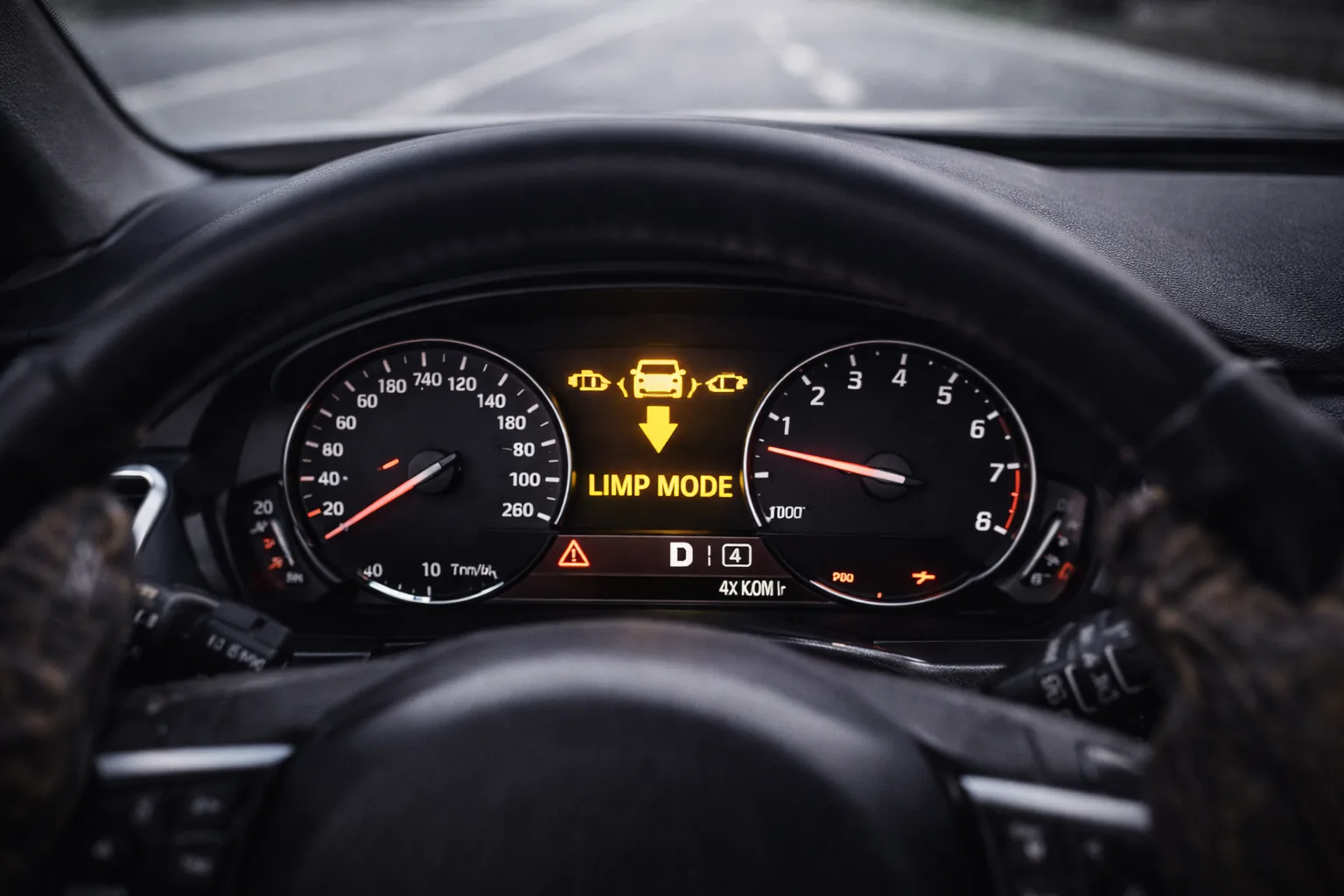
Limp mode is a protection strategy: when the ECU detects a value that could damage the engine, transmission or emissions system, it limits power.
What Is Limp Mode?
.imported-article{ --bg: #06110B; --card: #12281A; --ink: #F5F7FA; --muted: #AEB8C2; --accent: #58CF0D; --accent-light: #7FE836; --accent-2: #7FE836; --line: #1C3624; --line-light: #16321F; --shadow: 0 4px 24px rgba(0,0,0,0.35); --shadow-lg: 0 12px 48px rgba(0,0,0,0.45); --radius: 12px; --radius-sm: 8px; } .imported-article *{ box-sizing: border-box; margin: 0; padding: 0; } .imported-article{ font-size: 16px; scroll-behavior: smooth; } .imported-article{ font-family: "Mona Sans", system-ui, sans-serif; color: var(--ink); background: var(--bg); line-height: 1.75; font-weight: 400; -webkit-font-smoothing: antialiased; -moz-osx-font-smoothing: grayscale; } .imported-article a{ color: var(--accent-2); text-decoration: none; transition: color 0.2s ease; } .imported-article a:hover{ color: var(--accent); text-decoration: underline; } .imported-article .container{ max-width: 800px; margin: 0 auto; padding: 40px 24px 80px; } .imported-article /* Header / Hero */ .hero{ background: linear-gradient(135deg, var(--card) 0%, var(--line-light) 100%); border: 1px solid var(--line); border-radius: var(--radius); padding: 40px 36px; margin-bottom: 32px; box-shadow: var(--shadow); } .imported-article .badge{ display: inline-flex; align-items: center; font-family: "Mona Sans", system-ui, sans-serif; font-size: 0.75rem; font-weight: 600; letter-spacing: 0.05em; text-transform: uppercase; color: var(--accent); background: rgba(88, 207, 13, 0.14); padding: 8px 14px; border-radius: 20px; margin-bottom: 20px; } .imported-article .meta{ display: flex; align-items: center; gap: 16px; font-family: "Mona Sans", system-ui, sans-serif; font-size: 0.875rem; color: var(--muted); margin-bottom: 16px; } .imported-article .meta-item{ display: flex; align-items: center; gap: 6px; } .imported-article h1{ font-family: "Mona Sans", system-ui, sans-serif; font-size: 2.25rem; font-weight: 900; line-height: 1.2; letter-spacing: -0.02em; color: var(--ink); margin-bottom: 16px; } .imported-article .subtitle{ font-size: 1.125rem; color: var(--muted); line-height: 1.6; max-width: 90%; } .imported-article /* Table of Contents */ .toc{ margin-top: 28px; padding: 24px; background: rgba(255,255,255,0.04); border: 1px solid var(--line); border-radius: var(--radius-sm); } .imported-article .toc-title{ font-family: "Mona Sans", system-ui, sans-serif; text-transform: uppercase; letter-spacing: 0.08em; font-size: 0.75rem; font-weight: 600; color: var(--accent); margin-bottom: 12px; } .imported-article .toc ul{ list-style: none; } .imported-article .toc li{ margin: 8px 0; font-family: "Mona Sans", system-ui, sans-serif; font-size: 0.9rem; } .imported-article .toc a{ color: var(--ink); } .imported-article .toc a:hover{ color: var(--accent); } .imported-article .toc .toc-sub{ margin-left: 20px; font-size: 0.85rem; color: var(--muted); } .imported-article /* Article Content */ .article{ background: var(--card); border-radius: var(--radius); border: 1px solid var(--line); padding: 48px 40px; box-shadow: var(--shadow); } .imported-article .article h2{ font-family: "Mona Sans", system-ui, sans-serif; font-size: 1.625rem; font-weight: 700; margin: 2.5rem 0 1rem; padding-top: 1.5rem; border-top: 1px solid var(--line-light); color: var(--ink); letter-spacing: -0.01em; } .imported-article .article h2:first-child{ margin-top: 0; padding-top: 0; border-top: none; } .imported-article .article h3{ font-family: "Mona Sans", system-ui, sans-serif; font-size: 1.25rem; font-weight: 700; margin: 1.75rem 0 0.75rem; color: var(--ink); } .imported-article .article p{ margin: 1rem 0; font-size: 1.0625rem; } .imported-article .article ul, .imported-article .article ol{ margin: 1rem 0 1.25rem 1.5rem; } .imported-article .article li{ margin: 0.5rem 0; font-size: 1.0625rem; } .imported-article .article li::marker{ color: var(--accent); } .imported-article .article strong{ font-weight: 600; color: var(--ink); } .imported-article .article hr{ border: none; height: 1px; background: var(--line-light); margin: 2rem 0; } .imported-article /* Tags */ .tags{ margin-top: 3rem; padding-top: 2rem; border-top: 1px solid var(--line); } .imported-article .tags h2{ font-family: "Mona Sans", system-ui, sans-serif; font-size: 0.875rem; font-weight: 600; text-transform: uppercase; letter-spacing: 0.05em; color: var(--muted); margin-bottom: 12px; border: none; padding: 0; } .imported-article .tag-list{ list-style: none; display: flex; flex-wrap: wrap; gap: 8px; } .imported-article .tag-list li{ font-family: "Mona Sans", system-ui, sans-serif; background: var(--line-light); border: 1px solid var(--line); border-radius: 20px; padding: 6px 14px; font-size: 0.8125rem; font-weight: 500; color: var(--muted); transition: all 0.2s ease; } .imported-article .tag-list li:hover{ background: rgba(88, 207, 13, 0.14); border-color: var(--accent); color: var(--accent); } .imported-article /* Footer */ .footer{ text-align: center; font-family: "Mona Sans", system-ui, sans-serif; color: var(--muted); font-size: 0.875rem; margin-top: 40px; padding-top: 24px; border-top: 1px solid var(--line); } .imported-article .footer a{ color: var(--accent); font-weight: 500; } .imported-article /* Responsive */ @media (max-width: 768px){ .container { padding: 24px 16px 60px; } .hero { padding: 28px 24px; } h1 { font-size: 1.75rem; } .article { padding: 32px 24px; } .article h2 { font-size: 1.375rem; } .article p, .article li { font-size: 1rem; } .meta { flex-wrap: wrap; gap: 10px; } } .imported-article /* Print styles */ @media print{ .toc, .tags, .badge, .footer { display: none; } .hero, .article { box-shadow: none; border: none; } body { font-size: 12pt; } } .imported-article .container{max-width:100%;padding:0;margin:0;}.meta{display:flex;flex-wrap:wrap;gap:8px 18px;align-items:center}.meta-item{display:inline-flex;gap:6px;align-items:center}.meta-item svg{width:16px;height:16px;flex:none} ReproRACE - Technical Guide By the ReproRACE Team 2 min read Contents How the Engine Control Unit Makes Decisions The Most Common Causes Why It Sometimes Clears on Its Own What to Do When It Happens Complete Guide and Next Steps Conclusion What Is Limp Mode? It’s a protective strategy: when the engine control unit detects a value that could damage the engine, transmission, or emissions system, it limits power and engine speed so you can make it to a repair shop. It’s not the fault itself, but the response to it. Also read about emissions-related limp mode and emissions-related power loss . How the Engine Control Unit Makes Decisions Every important parameter has an expected value and a tolerance range. If a reading falls outside that range for a certain amount of time, a code is stored and, depending on its severity, one of these responses is triggered: Level Response Example Warning The code is stored only Small gasoline vapor leak Soft limitation Maximum torque is reduced Temperature sensor reading is questionable Limp mode Minimum boost pressure and limited engine speed Boost pressure too high or too low Full protection Fuel injection cut-off or shutdown Oil pressure, overspeed The most common causes Turbo: pressure outside the requested range ( P0299 , P0234 ). Fuel: low rail pressure ( P0087 ). Saturated particulate filter ( P2463 ). Sensors: mass airflow, manifold pressure, accelerator ( P0101 , P0106 , P0121 ). Low battery voltage ( P0562 ). Automatic transmission ( P0700 , P0730 ). Why it sometimes goes away on its own Many control units lift the restriction after a restart if the fault isn’t present at that moment. This can happen with variable geometry that sticks only during hard acceleration, or with a connector that fails due to vibration. The code remains stored, and the restriction will return. What to do when it happens Stay calm: acceleration will be limited, but the steering and brakes will still work. Pull off the road safely and turn off the engine for a minute. Check the fluid levels and make sure no hoses are loose. Don’t clear the code: the freeze-frame data is the workshop’s best clue. Complete guide and next steps The causes, along with their tables, codes, and an example involving a modified car, are covered in why does a car go into limp mode and lose power? . If the restriction is caused by an emissions control system, see emissions-related limp mode . Conclusion Limp mode protects the vehicle. Restarting may restore power for a while, but the solution is to find the value that went out of range. Tags limp mode limp mode power loss turbo diagnostics Related ReproRACE services Why a car goes into limp mode Car remapping Find your vehicle and check its power gains ReproRACE remapping workshops near you Stage 1 remapping Faults and fault codes ReproRACE — ReproRACE - engine electronics with technical expertise.