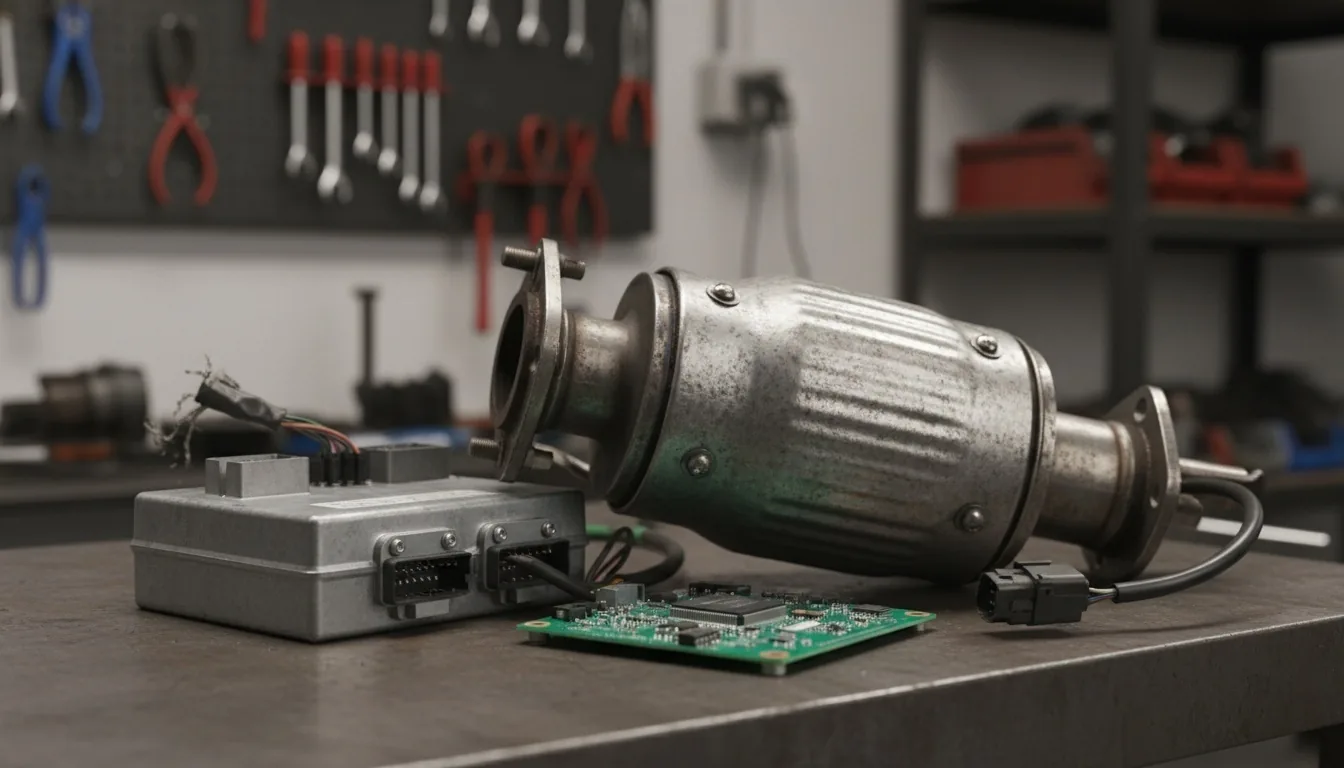
How a diesel particulate filter traps soot, how it burns it off through regeneration and why it is so important in a modern diesel engine.
Introduction
.imported-article{ --bg: #06110B; --card: #12281A; --ink: #F5F7FA; --muted: #AEB8C2; --accent: #58CF0D; --accent-light: #7FE836; --accent-2: #7FE836; --line: #1C3624; --line-light: #16321F; --shadow: 0 4px 24px rgba(0,0,0,0.35); --shadow-lg: 0 12px 48px rgba(0,0,0,0.45); --radius: 12px; --radius-sm: 8px; } .imported-article *{ box-sizing: border-box; margin: 0; padding: 0; } .imported-article{ font-size: 16px; scroll-behavior: smooth; } .imported-article{ font-family: "Mona Sans", system-ui, sans-serif; color: var(--ink); background: var(--bg); line-height: 1.75; font-weight: 400; -webkit-font-smoothing: antialiased; -moz-osx-font-smoothing: grayscale; } .imported-article a{ color: var(--accent-2); text-decoration: none; transition: color 0.2s ease; } .imported-article a:hover{ color: var(--accent); text-decoration: underline; } .imported-article .container{ max-width: 800px; margin: 0 auto; padding: 40px 24px 80px; } .imported-article /* Header / Hero */ .hero{ background: linear-gradient(135deg, var(--card) 0%, var(--line-light) 100%); border: 1px solid var(--line); border-radius: var(--radius); padding: 40px 36px; margin-bottom: 32px; box-shadow: var(--shadow); } .imported-article .badge{ display: inline-flex; align-items: center; font-family: "Mona Sans", system-ui, sans-serif; font-size: 0.75rem; font-weight: 600; letter-spacing: 0.05em; text-transform: uppercase; color: var(--accent); background: rgba(88, 207, 13, 0.14); padding: 8px 14px; border-radius: 20px; margin-bottom: 20px; } .imported-article .meta{ display: flex; align-items: center; gap: 16px; font-family: "Mona Sans", system-ui, sans-serif; font-size: 0.875rem; color: var(--muted); margin-bottom: 16px; } .imported-article .meta-item{ display: flex; align-items: center; gap: 6px; } .imported-article h1{ font-family: "Mona Sans", system-ui, sans-serif; font-size: 2.25rem; font-weight: 900; line-height: 1.2; letter-spacing: -0.02em; color: var(--ink); margin-bottom: 16px; } .imported-article .subtitle{ font-size: 1.125rem; color: var(--muted); line-height: 1.6; max-width: 90%; } .imported-article /* Table of Contents */ .toc{ margin-top: 28px; padding: 24px; background: rgba(255,255,255,0.04); border: 1px solid var(--line); border-radius: var(--radius-sm); } .imported-article .toc-title{ font-family: "Mona Sans", system-ui, sans-serif; text-transform: uppercase; letter-spacing: 0.08em; font-size: 0.75rem; font-weight: 600; color: var(--accent); margin-bottom: 12px; } .imported-article .toc ul{ list-style: none; } .imported-article .toc li{ margin: 8px 0; font-family: "Mona Sans", system-ui, sans-serif; font-size: 0.9rem; } .imported-article .toc a{ color: var(--ink); } .imported-article .toc a:hover{ color: var(--accent); } .imported-article .toc .toc-sub{ margin-left: 20px; font-size: 0.85rem; color: var(--muted); } .imported-article /* Article Content */ .article{ background: var(--card); border-radius: var(--radius); border: 1px solid var(--line); padding: 48px 40px; box-shadow: var(--shadow); } .imported-article .article h2{ font-family: "Mona Sans", system-ui, sans-serif; font-size: 1.625rem; font-weight: 700; margin: 2.5rem 0 1rem; padding-top: 1.5rem; border-top: 1px solid var(--line-light); color: var(--ink); letter-spacing: -0.01em; } .imported-article .article h2:first-child{ margin-top: 0; padding-top: 0; border-top: none; } .imported-article .article h3{ font-family: "Mona Sans", system-ui, sans-serif; font-size: 1.25rem; font-weight: 700; margin: 1.75rem 0 0.75rem; color: var(--ink); } .imported-article .article p{ margin: 1rem 0; font-size: 1.0625rem; } .imported-article .article ul, .imported-article .article ol{ margin: 1rem 0 1.25rem 1.5rem; } .imported-article .article li{ margin: 0.5rem 0; font-size: 1.0625rem; } .imported-article .article li::marker{ color: var(--accent); } .imported-article .article strong{ font-weight: 600; color: var(--ink); } .imported-article .article hr{ border: none; height: 1px; background: var(--line-light); margin: 2rem 0; } .imported-article /* Tags */ .tags{ margin-top: 3rem; padding-top: 2rem; border-top: 1px solid var(--line); } .imported-article .tags h2{ font-family: "Mona Sans", system-ui, sans-serif; font-size: 0.875rem; font-weight: 600; text-transform: uppercase; letter-spacing: 0.05em; color: var(--muted); margin-bottom: 12px; border: none; padding: 0; } .imported-article .tag-list{ list-style: none; display: flex; flex-wrap: wrap; gap: 8px; } .imported-article .tag-list li{ font-family: "Mona Sans", system-ui, sans-serif; background: var(--line-light); border: 1px solid var(--line); border-radius: 20px; padding: 6px 14px; font-size: 0.8125rem; font-weight: 500; color: var(--muted); transition: all 0.2s ease; } .imported-article .tag-list li:hover{ background: rgba(88, 207, 13, 0.14); border-color: var(--accent); color: var(--accent); } .imported-article /* Footer */ .footer{ text-align: center; font-family: "Mona Sans", system-ui, sans-serif; color: var(--muted); font-size: 0.875rem; margin-top: 40px; padding-top: 24px; border-top: 1px solid var(--line); } .imported-article .footer a{ color: var(--accent); font-weight: 500; } .imported-article /* Responsive */ @media (max-width: 768px){ .container { padding: 24px 16px 60px; } .hero { padding: 28px 24px; } h1 { font-size: 1.75rem; } .article { padding: 32px 24px; } .article h2 { font-size: 1.375rem; } .article p, .article li { font-size: 1rem; } .meta { flex-wrap: wrap; gap: 10px; } } .imported-article /* Print styles */ @media print{ .toc, .tags, .badge, .footer { display: none; } .hero, .article { box-shadow: none; border: none; } body { font-size: 12pt; } } .imported-article .container{max-width:100%;padding:0;margin:0;}.meta{display:flex;flex-wrap:wrap;gap:8px 18px;align-items:center}.meta-item{display:inline-flex;gap:6px;align-items:center}.meta-item svg{width:16px;height:16px;flex:none} ReproRACE - Technical Guide By the ReproRACE Team 10 min read Contents What Is the DPF Filter? Why the DPF Is Essential in Modern Diesel Engines How the DPF Filter Works, Step by Step 1\. Particle trapping 2\. Gradual soot buildup 3\. DPF regeneration Types of DPF Regeneration Passive regeneration Active regeneration Forced regeneration at a workshop Which Sensors Are Involved in DPF Operation? The Relationship Between the DPF and Engine Management Electronics What Happens When the DPF Cannot Regenerate Properly? The DPF and Driving Style Common Myths About the DPF Filter “The DPF always cleans itself” “If the warning light doesn’t come on, there’s no problem” “The DPF only fails in older cars” The Importance of Professional DPF Diagnostics DPF Internal Architecture and What It Means Sensors involved and how the information is interpreted Soot load modeling and ash management Passive, active, and forced regeneration: the real differences How the DPF relates to the EGR, turbocharger, and fuel injection Common diagnostic errors Why clearing fault codes does not solve the problem What data to check during a professional diagnosis Conclusion Introduction The diesel particulate filter , commonly known as the DPF (Diesel Particulate Filter) , is one of the most important—and at the same time most misunderstood—components of modern diesel engines. It has been mandatory in most diesel vehicles since the Euro 5 emissions standard, and its proper operation is key both to pollutant emissions and to engine performance and reliability . Understanding what the DPF is and how it really works not only helps prevent breakdowns, but also makes it easier to interpret many common problems related to loss of power, increased fuel consumption, or electronic faults. In this article, we explain how it works in a clear, technical, and realistic way, from the perspective of engine electronic management . What is the DPF? The DPF is a filter installed in the exhaust system of diesel engines whose main function is to trap solid particles (soot) produced during combustion. These particles are highly polluting and are regulated by European emissions standards. The particulate filter acts as a physical barrier that: Traps soot Allows exhaust gases to pass through Prevents solid particles from escaping During normal engine operation, the DPF gradually fills with particles, so it needs a system that can clean it automatically . Why the DPF is essential in modern diesel engines Modern diesel engines operate with: High injection pressures Lean mixtures Variable temperatures These conditions improve efficiency, but they also generate more solid particles. Without the DPF: Emissions would be unacceptable The engine would not meet regulations The vehicle could not be type-approved Therefore, the DPF is not an optional add-on, but an integral part of the engine management system . How the DPF works, step by step The DPF works through two key processes: filtration and regeneration . 1\. Particle retention When exhaust gases pass through the filter: Solid particles are trapped in the internal structure Clean gases continue out of the filter This structure is usually made of ceramic materials with microscopic channels that enable highly efficient filtration. 2\. Gradual soot buildup As the vehicle is used, the filter accumulates: Soot (carbon deposits) Ash (non-combustible residues) This buildup is inevitable and is part of the system’s normal operation. 3\. DPF regeneration To prevent the filter from becoming clogged, the ECU manages processes called DPF regenerations , which are intended to burn off the accumulated soot by raising the filter’s temperature. There are several types of regeneration. Types of DPF regeneration Passive regeneration This occurs naturally when: The engine runs under a constant load Exhaust temperatures are high enough This is common when driving on roads or highways. Active regeneration When the ECU detects that the DPF is becoming too loaded, it initiates a forced regeneration by means of: Fuel post-injections Adjustments to engine management A controlled increase in exhaust temperature This type of regeneration is fully automatic and depends on multiple electronic parameters. Forced regeneration in a workshop If automatic regenerations are not sufficient, a controlled regeneration can be performed using diagnostic equipment, provided the system’s condition allows it. Which sensors are involved in DPF operation The DPF does not operate in isolation. It is constantly monitored by the ECU through various sensors: DPF differential pressure sensor Exhaust gas temperature sensors Oxygen / lambda sensors Engine load sensors These sensors allow the ECU to: Calculate the saturation level Decide when to regenerate Activate protection strategies if necessary A fault in any of these sensors can cause serious problems with DPF operation . The relationship between the DPF and electronic engine management The particulate filter is not a passive component. It is part of a complex electronic strategy , in which the ECU analyzes the following in real time: Driving style Temperatures Exhaust pressure Engine load Regeneration history If any of these parameters fall outside the normal range, the ECU may: Increase regeneration frequency Limit engine power Activate protection mode That is why many DPF problems are accompanied by loss of power or electronic warnings . What happens when the DPF cannot regenerate properly When the DPF fails to regenerate properly: Exhaust back pressure increases Engine performance decreases Fuel consumption increases Electronic faults occur If the situation persists, the filter can reach a point of critical saturation , where the only solution is advanced technical intervention. DPF and driving style Driving style directly affects the service life of the DPF: Exclusively urban driving → higher risk of clogging Short trips → incomplete regenerations Consistently driving at low RPM → soot buildup By contrast, varied driving at the proper temperature promotes healthy system operation. Common myths about the DPF “The DPF always cleans itself” False. It needs specific conditions to regenerate properly. “If the warning light doesn’t come on, there’s no problem” Incorrect. Many DPF faults develop gradually and don’t trigger an immediate warning. “The DPF only fails in old cars” Wrong. Modern engines can also develop problems if conditions aren’t right. The importance of professional DPF diagnostics A proper diagnosis should assess: The filter’s actual soot load Sensor condition Regeneration history Active electronic strategies Clearing fault codes without understanding the source of the problem does not solve the root cause . DPF internal structure and what it means The DPF is not just a “pipe with a filter.” Its internal structure consists of a ceramic monolith with alternating blocked channels, forcing the gases to pass through porous walls before exiting. This design has clear technical implications: The porosity determines filtration efficiency and pressure drop. The ceramic material determines thermal resistance during regenerations. The channel design affects the rate of soot buildup. As soot accumulates, exhaust gas flow becomes restricted. If the filter design and electronic control do not maintain a balance, backpressure rises, the turbo operates outside its optimal map, and engine efficiency drops. That is why the DPF is considered a management system, not just a passive component. Sensors involved and how the information is interpreted To manage the DPF, the ECU uses a combination of sensors and internal models. The most relevant are: Differential pressure sensor : it is the basis for estimating the actual load. If its tubes become clogged or the sensor drifts, the ECU detects saturation where there is none. Exhaust gas temperature sensors : they verify that regeneration reaches the required temperature range. If the temperature is not reached, regeneration is considered incomplete. Mass airflow meter and MAP sensor : they help calculate the actual exhaust gas flow and the air/fuel ratio, essential data for estimating particle production. Lambda sensor (in some modern diesel engines) : it allows combustion conditions to be fine-tuned and residual oxygen to be monitored. This data is not interpreted in isolation. The ECU uses cross-checking for plausibility , comparing signals with one another and against internal models. That is why a sensor fault does not always generate a direct DTC for that sensor: it may appear as a DPF or regeneration fault. Soot load model and ash management The ECU calculates two different loads: soot and ash . Soot is combustible and can be removed through regeneration; ash comes from the oil and accumulates over time. The soot model uses: Engine speed and load. Air mass. Amount of fuel injected. EGR and exhaust gas temperature strategy. When the model estimates a high soot load, it requests regeneration. However, the ash model responds more slowly and is based on operating hours, oil consumption, and lubricant type. This explains why a DPF may stop regenerating properly even though regenerations are completed: ash saturation reduces the filter’s usable volume. Passive, active, and forced regeneration: the real differences Passive regeneration occurs when the engine runs under sufficient load and at a sufficiently high temperature. It is the healthiest type because it does not require additional injection strategies. Active regeneration comes into play when passive regeneration is not enough. The ECU performs post-injections to raise the exhaust gas temperature. This process has consequences: It increases fuel consumption. It can dilute the oil if it happens frequently. It requires the sensors and temperature to remain within range. Forced regeneration is used in a workshop when the soot level is high and active regeneration can no longer be carried out safely. It is not a solution if there are sensor faults or injection problems: in that case, it only masks the symptom, and saturation will quickly return. How the DPF relates to EGR, the turbo, and injection The DPF cannot be understood without considering how it relates to other systems: EGR : increases exhaust gas recirculation and can increase soot production if it is not properly controlled. Turbo : DPF backpressure changes the turbo’s response and can shift its efficiency range, producing more smoke and accelerating saturation. Injection : Poorly atomized fuel produces more particles. The ECU can compensate, but at the cost of more frequent regenerations and higher fuel consumption. This interdependence explains why a DPF problem is often the result of faults in other systems rather than the filter itself. Common diagnostic mistakes Interpreting a DTC as a definitive diagnosis . A P2002 does not mean “broken DPF”; it means the calculated efficiency is outside the specified range. Forcing regenerations without checking the sensors . If the differential pressure is being measured incorrectly, regeneration is not the solution. Ignoring ash saturation . An ash-filled filter cannot be restored through regeneration. Failing to check the oil . Dilution changes combustion and alters the load model. Why clearing fault codes does not solve the problem Clearing the code removes the warning, but it does not change the ECU logic or the system’s physical behavior. If differential pressure remains high or the internal model continues to detect excessive load, the DTC will reappear. That is why a proper diagnosis always analyzes live data, regeneration history, and sensor consistency before making decisions. What data to check during a professional diagnosis A complete diagnosis should include: Differential pressure at idle and at different engine speeds. Temperatures before and after the DPF during regeneration. Calculated soot load vs. actual load. Frequency of completed and interrupted regenerations. EGR, injector, and turbo status to rule out indirect causes. This data makes it possible to determine whether the DPF is actually saturated or whether the problem lies in the electronic management system. Conclusion Now that you know what the DPF filter is and how it really works , it is clear that it is not just a simple exhaust component, but a complex electromechanical system closely linked to engine operation. Understanding how it works, recognizing the first signs of failure, and taking action in time are essential to maintaining the reliability, performance, and efficiency of a diesel engine. At ReproRACE, we approach the DPF system from a technical, preventive, and reliability-focused perspective , always analyzing the electronic strategy before applying any solution. Tags particulate filter clogged DPF DPF regeneration DPF malfunction DPF cleaning engine electronics advanced diagnostics error code electronic fault specialist workshop Related ReproRACE services Clogged particulate filter: what to do FAP/DPF software deactivation Find your vehicle and check its performance gains ReproRACE tuning workshops near you Stage 1 remapping Faults and fault codes ReproRACE — ReproRACE - engine electronics backed by technical expertise.