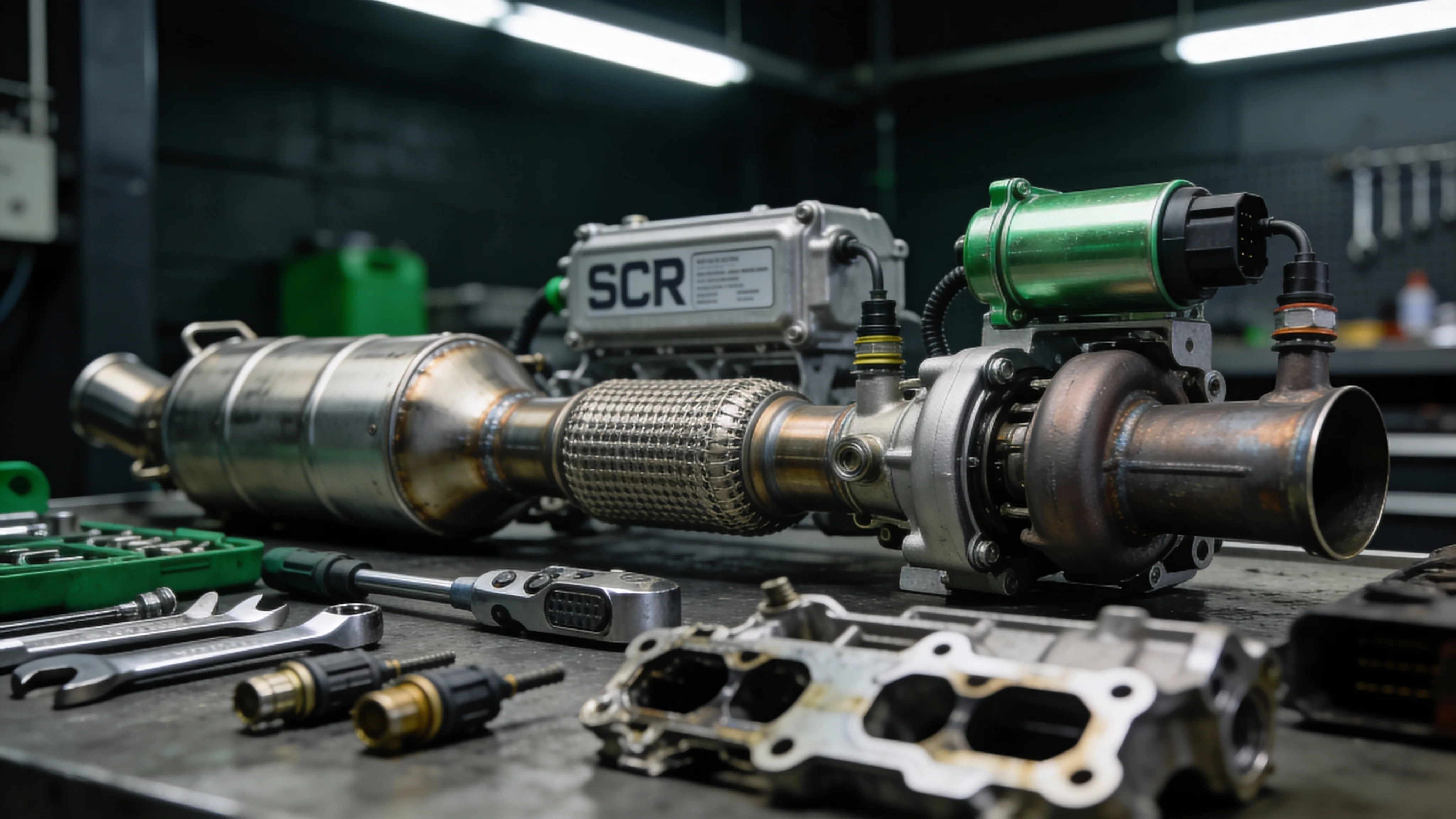
The AdBlue (SCR) system is one of the cornerstones of emissions reduction in modern diesel engines.
Introduction
.imported-article{ --bg: #06110B; --card: #12281A; --ink: #F5F7FA; --muted: #AEB8C2; --accent: #58CF0D; --accent-light: #7FE836; --accent-2: #7FE836; --line: #1C3624; --line-light: #16321F; --shadow: 0 4px 24px rgba(0,0,0,0.35); --shadow-lg: 0 12px 48px rgba(0,0,0,0.45); --radius: 12px; --radius-sm: 8px; } .imported-article *{ box-sizing: border-box; margin: 0; padding: 0; } .imported-article{ font-size: 16px; scroll-behavior: smooth; } .imported-article{ font-family: "Mona Sans", system-ui, sans-serif; color: var(--ink); background: var(--bg); line-height: 1.75; font-weight: 400; -webkit-font-smoothing: antialiased; -moz-osx-font-smoothing: grayscale; } .imported-article a{ color: var(--accent-2); text-decoration: none; transition: color 0.2s ease; } .imported-article a:hover{ color: var(--accent); text-decoration: underline; } .imported-article .container{ max-width: 800px; margin: 0 auto; padding: 40px 24px 80px; } .imported-article /* Header / Hero */ .hero{ background: linear-gradient(135deg, var(--card) 0%, var(--line-light) 100%); border: 1px solid var(--line); border-radius: var(--radius); padding: 40px 36px; margin-bottom: 32px; box-shadow: var(--shadow); } .imported-article .badge{ display: inline-flex; align-items: center; font-family: "Mona Sans", system-ui, sans-serif; font-size: 0.75rem; font-weight: 600; letter-spacing: 0.05em; text-transform: uppercase; color: var(--accent); background: rgba(88, 207, 13, 0.14); padding: 8px 14px; border-radius: 20px; margin-bottom: 20px; } .imported-article .meta{ display: flex; align-items: center; gap: 16px; font-family: "Mona Sans", system-ui, sans-serif; font-size: 0.875rem; color: var(--muted); margin-bottom: 16px; } .imported-article .meta-item{ display: flex; align-items: center; gap: 6px; } .imported-article h1{ font-family: "Mona Sans", system-ui, sans-serif; font-size: 2.25rem; font-weight: 900; line-height: 1.2; letter-spacing: -0.02em; color: var(--ink); margin-bottom: 16px; } .imported-article .subtitle{ font-size: 1.125rem; color: var(--muted); line-height: 1.6; max-width: 90%; } .imported-article /* Table of Contents */ .toc{ margin-top: 28px; padding: 24px; background: rgba(255,255,255,0.04); border: 1px solid var(--line); border-radius: var(--radius-sm); } .imported-article .toc-title{ font-family: "Mona Sans", system-ui, sans-serif; text-transform: uppercase; letter-spacing: 0.08em; font-size: 0.75rem; font-weight: 600; color: var(--accent); margin-bottom: 12px; } .imported-article .toc ul{ list-style: none; } .imported-article .toc li{ margin: 8px 0; font-family: "Mona Sans", system-ui, sans-serif; font-size: 0.9rem; } .imported-article .toc a{ color: var(--ink); } .imported-article .toc a:hover{ color: var(--accent); } .imported-article .toc .toc-sub{ margin-left: 20px; font-size: 0.85rem; color: var(--muted); } .imported-article /* Article Content */ .article{ background: var(--card); border-radius: var(--radius); border: 1px solid var(--line); padding: 48px 40px; box-shadow: var(--shadow); } .imported-article .article h2{ font-family: "Mona Sans", system-ui, sans-serif; font-size: 1.625rem; font-weight: 700; margin: 2.5rem 0 1rem; padding-top: 1.5rem; border-top: 1px solid var(--line-light); color: var(--ink); letter-spacing: -0.01em; } .imported-article .article h2:first-child{ margin-top: 0; padding-top: 0; border-top: none; } .imported-article .article h3{ font-family: "Mona Sans", system-ui, sans-serif; font-size: 1.25rem; font-weight: 700; margin: 1.75rem 0 0.75rem; color: var(--ink); } .imported-article .article p{ margin: 1rem 0; font-size: 1.0625rem; } .imported-article .article ul, .imported-article .article ol{ margin: 1rem 0 1.25rem 1.5rem; } .imported-article .article li{ margin: 0.5rem 0; font-size: 1.0625rem; } .imported-article .article li::marker{ color: var(--accent); } .imported-article .article strong{ font-weight: 600; color: var(--ink); } .imported-article .article hr{ border: none; height: 1px; background: var(--line-light); margin: 2rem 0; } .imported-article /* Tags */ .tags{ margin-top: 3rem; padding-top: 2rem; border-top: 1px solid var(--line); } .imported-article .tags h2{ font-family: "Mona Sans", system-ui, sans-serif; font-size: 0.875rem; font-weight: 600; text-transform: uppercase; letter-spacing: 0.05em; color: var(--muted); margin-bottom: 12px; border: none; padding: 0; } .imported-article .tag-list{ list-style: none; display: flex; flex-wrap: wrap; gap: 8px; } .imported-article .tag-list li{ font-family: "Mona Sans", system-ui, sans-serif; background: var(--line-light); border: 1px solid var(--line); border-radius: 20px; padding: 6px 14px; font-size: 0.8125rem; font-weight: 500; color: var(--muted); transition: all 0.2s ease; } .imported-article .tag-list li:hover{ background: rgba(88, 207, 13, 0.14); border-color: var(--accent); color: var(--accent); } .imported-article /* Footer */ .footer{ text-align: center; font-family: "Mona Sans", system-ui, sans-serif; color: var(--muted); font-size: 0.875rem; margin-top: 40px; padding-top: 24px; border-top: 1px solid var(--line); } .imported-article .footer a{ color: var(--accent); font-weight: 500; } .imported-article /* Responsive */ @media (max-width: 768px){ .container { padding: 24px 16px 60px; } .hero { padding: 28px 24px; } h1 { font-size: 1.75rem; } .article { padding: 32px 24px; } .article h2 { font-size: 1.375rem; } .article p, .article li { font-size: 1rem; } .meta { flex-wrap: wrap; gap: 10px; } } .imported-article /* Print styles */ @media print{ .toc, .tags, .badge, .footer { display: none; } .hero, .article { box-shadow: none; border: none; } body { font-size: 12pt; } } .imported-article .container{max-width:100%;padding:0;margin:0;}.meta{display:flex;flex-wrap:wrap;gap:8px 18px;align-items:center}.meta-item{display:inline-flex;gap:6px;align-items:center}.meta-item svg{width:16px;height:16px;flex:none} ReproRACE - Technical Guide By the ReproRACE Team 11 min read Contents What the AdBlue (SCR) system is and why it depends on sensors Electronic architecture of the AdBlue system Main sensors in the AdBlue system 1. AdBlue level sensor 2. Urea quality or concentration sensor 3. AdBlue temperature sensor 4. AdBlue circuit pressure sensor 5. NOx sensors (upstream and downstream of the SCR) 6. Exhaust gas temperature (EGT) sensors Most common sensor-related AdBlue system faults How the ECU decides AdBlue dosing Typical symptoms of AdBlue sensor failures DTCs and SCR system protection logic Professional diagnosis of AdBlue faults Case study: AdBlue quality sensor failure Preventive maintenance of the AdBlue system Plausibility checks the ECU runs on the SCR How AdBlue faults affect performance and fuel consumption Most common diagnostic errors Best practices to prevent crystallization AdBlue systems in commercial and industrial vehicles Step-by-step inspection procedure Relationship with OBD and emissions inspections Secondary sensors that affect the SCR Protection strategies when a sensor fails Quick checklist for AdBlue faults Why real data matters in AdBlue systems Conclusion Introduction The AdBlue (SCR) system is one of the cornerstones of emissions reduction in modern diesel engines. Its operation depends on a precise electronic chain: without reliable sensors, the ECU cannot calculate the correct dosing or ensure that NOx emissions stay within regulatory limits. That is why AdBlue system faults are usually electronic rather than mechanical. Out-of-range sensors, implausible signals or power supply failures trigger warnings, power loss and protection modes that directly affect performance. In this article we take an in-depth look at which sensors are involved in the AdBlue system and their most common failures. What the AdBlue (SCR) system is and why it depends on sensors The SCR (Selective Catalytic Reduction) system injects a urea solution (AdBlue) into the exhaust to reduce NOx. This chemical reaction requires control of: Exhaust gas temperature Amount of urea injected Condition of the SCR catalyst AdBlue level and quality If any of this data is wrong, the ECU cannot guarantee NOx reduction. That is why SCR logic is fundamentally electronic: the ECU decides the dosing and validates the result using sensors. Electronic architecture of the AdBlue system The system is made up of several components managed by the ECU or by a separate SCR control unit: AdBlue tank with built-in sensors Pump and pressure module Injector or doser in the exhaust NOx sensors upstream and downstream of the catalyst Exhaust gas temperature sensors The ECU uses this data to adjust dosing and to trigger protection strategies if it detects inconsistencies. This confirms a key principle: the ECU decides, not the driver . Main sensors in the AdBlue system 1. AdBlue level sensor Function: report the amount of AdBlue available so the system never runs dry. Common failures: Erratic readings due to vibration or foam Sensor blocked by urea crystals Calibration errors after partial refills Symptoms: false low-level warnings, no-start countdown messages or power limitation if the ECU interprets a lack of AdBlue. 2. Urea quality or concentration sensor Function: verify that the urea concentration is correct (approx. 32.5%). Common failures: Fluid contamination Sensor degraded by temperature Implausible readings due to aging Symptoms: “incorrect AdBlue quality” warnings and activation of protection mode. 3. AdBlue temperature sensor Function: monitor fluid temperature and prevent dosing when it is frozen. Common failures: Open circuit or short circuit in the sensor Unstable readings due to vibration Tank heater failures Symptoms: the system does not start dosing when cold and heater DTCs appear. 4. AdBlue circuit pressure sensor Function: ensure the system maintains the pressure needed for injection. Common failures: Pressure loss due to leaks Faulty pressure sensor Worn or dirty pump Symptoms: insufficient dosing, low-pressure codes and power loss. 5. NOx sensors (upstream and downstream of the SCR) Function: measure the amount of nitrogen oxides to calculate SCR efficiency. Common failures: Sensor aged by extreme temperatures Slow or out-of-range signals Heat-damaged wiring Symptoms: SCR efficiency errors, power limitation and emissions system fault messages. 6. Exhaust gas temperature (EGT) sensors Function: confirm that exhaust temperature is high enough for the chemical reaction. Common failures: Drift due to aging Implausible signals under high load Intermittent electrical faults Symptoms: erratic regenerations, blocked dosing and emissions alerts. Most common sensor-related AdBlue system faults Typical faults are not in the catalyst but in the measurement. The most frequent are: Urea crystallization in sensors and lines Freezing of the fluid in winter Contamination of the AdBlue due to incorrect mixtures Electrical faults in connectors due to moisture Implausible readings between NOx and temperature sensors The result is usually a system in protection mode and power loss, even though the engine is running correctly. How the ECU decides AdBlue dosing The ECU calculates dosing based on: Load and requested torque Exhaust gas temperature NOx reading upstream of the SCR Efficiency measured downstream of the SCR If the response is not consistent, the ECU increases or reduces dosing. When the problem persists, it activates protection modes. That is why a wrong reading from a single sensor can cause a chain of errors throughout the system. Typical symptoms of AdBlue sensor failures When AdBlue system sensors fail, the usual signs are: Emissions system fault warnings No-start countdown Power limitation Increased fuel consumption Quality, pressure or NOx DTCs The absence of smoke or mechanical faults does not mean the system is fine. The ECU limits power even though the engine is running correctly. DTCs and SCR system protection logic AdBlue-related DTCs usually trigger strict strategies. The ECU treats faults as a risk of illegal emissions and puts NOx reduction ahead of performance. This explains why AdBlue warnings are often accompanied by power limitation or no-start messages. A DTC is not a diagnosis. It is a symptom that must be analyzed with real data and operating context. Professional diagnosis of AdBlue faults A complete diagnosis should include: Reading current, pending and stored DTCs Checking circuit pressure Reviewing NOx sensors in live data Verifying exhaust gas and tank temperatures Active tests of the doser Only then is it possible to tell an electronic failure apart from a genuine SCR problem. Case study: AdBlue quality sensor failure A vehicle shows an “incorrect AdBlue quality” warning a few days after a refill. The system goes into protection mode, but there is no severe power loss or smoke. After analyzing live data, it turns out the quality sensor is sending unstable values. The tank is inspected and contamination with the wrong fluid is found. Unable to validate the concentration, the ECU activates protection. The solution was not replacing the catalyst, but cleaning the tank, replacing the sensor and resetting the system. This case shows that measurement is the critical point . Preventive maintenance of the AdBlue system To reduce sensor failures: Always use certified AdBlue Avoid storing the fluid in open containers Refill with a clean, uncontaminated funnel Check the system before warnings appear Inspect connectors in areas exposed to moisture These simple measures reduce the likelihood of electronic failures and extend the system's service life. Plausibility checks the ECU runs on the SCR The ECU does not simply read sensors in isolation. It cross-checks data to validate plausibility: Comparison between NOx upstream and downstream of the catalyst Relationship between exhaust gas temperature and reduction efficiency Verification of circuit pressure during dosing Correlation between air mass and engine load If the relationships do not make sense, the ECU assumes a system fault and limits power. This cross-checking explains why a single faulty sensor can affect the whole system. How AdBlue faults affect performance and fuel consumption When the system goes into protection mode, the ECU reduces available torque and limits engine speed to protect emissions. The result is a feeling of lack of power and, at times, higher fuel consumption, because the engine is working outside its optimal point. In addition, incorrect dosing can saturate the SCR catalyst or cause NOx sensor failures, amplifying the problem. Most common diagnostic errors Non-specialist workshops tend to repeat the same mistakes: Replacing the catalyst without validating the sensors Clearing DTCs without checking real data Ignoring wiring and power supply Not checking the condition of the tank and the fluid These mistakes increase costs and do not fix the root cause. Best practices to prevent crystallization Urea crystallization is one of the main causes of sensor and line failures. To prevent it: Do not leave the vehicle for long periods with AdBlue in extreme conditions Prevent injector leaks that cause deposits Always use quality fluid and sealed containers Check the system after use in very cold weather A short preventive routine eliminates a large share of electronic failures. AdBlue systems in commercial and industrial vehicles In trucks and heavy machinery, the SCR system works under more demanding conditions: long cycles, high temperatures and heavier loads. This increases wear on NOx and pressure sensors. In addition, downtime on a commercial vehicle means direct financial losses, so preventive diagnostics and monitoring sensor trends are key to avoiding critical failures. Step-by-step inspection procedure When an AdBlue fault appears, diagnosis should follow a logical order: Confirm AdBlue level and quality Review DTCs and live NOx sensor data Verify circuit pressure and pump operation Check exhaust gas temperatures under real conditions Validate the injector with active tests This method avoids replacing one component after another and helps locate the real cause faster. Relationship with OBD and emissions inspections The AdBlue system is tied to the OBD emissions monitors. If the ECU detects sensor faults, the monitors remain in a not-ready state and the vehicle may fail the roadworthiness inspection. Even with the warning light off, the system may be locked out and cause an inspection failure. That is why clearing codes is not enough after a repair: drive cycles must be completed to validate SCR operation. Secondary sensors that affect the SCR In addition to the main sensors, the ECU may use exhaust pressure, intake temperature or airflow signals to adjust the NOx model. If these signals fail, dosing becomes less accurate and the system goes into protection mode. In advanced diagnostics, these secondary sensors must be checked to avoid false AdBlue fault positives. Protection strategies when a sensor fails If an SCR sensor fails, the ECU activates staged protection strategies. First it reduces dosing to avoid damaging the catalyst. If the inconsistency persists, it logs DTCs and may limit torque. In severe cases, it starts a no-start countdown to comply with regulations. This logic explains why a seemingly minor electronic fault ends in power loss: the emissions control system has legal priority. Quick checklist for AdBlue faults Confirm the AdBlue is correct and clean Review NOx and temperature sensors in live data Check pressure and pump operation Validate connections and grounds Complete a drive cycle after the repair This checklist serves as an initial guide before moving on to advanced tests. Why real data matters in AdBlue systems In the SCR system, live values are more reliable than any assumption. NOx readings, dosing pressure and exhaust gas temperature tell you whether the system is working or whether the ECU has locked it out. Without this data, it is easy to mistake a sensor failure for a catalyst problem. A diagnosis based on real data reduces labor time, avoids unnecessary replacements and improves long-term reliability. In modern systems, a small offset in one sensor can upset the entire dosing strategy and cause recurring faults. That is why a preventive approach pays off more than waiting for the system to lock out. This explains why many vehicles arrive at the workshop with intermittent warnings: the ECU is validating plausibility before activating a permanent limitation. Important. Conclusion The AdBlue system sensors are at the core of electronic SCR control. Most faults originate from implausible readings, fluid contamination or electrical failures, not from the catalyst itself. Understanding which sensor is failing, how it affects dosing and how the ECU reacts is key to avoiding misdiagnosis and unnecessary power loss. At ReproRACE we approach AdBlue faults from a technical, analytical and reliability-focused , always interpreting the entire system before intervening. Tags EGR valve Dirty EGR EGR failure EGR cleaning Disable EGR engine electronics advanced diagnostics error code electronic fault specialist workshop Related services from ReproRACE What to do if your AdBlue system fails AdBlue (SCR) software delete Find your vehicle and check its gains ReproRACE remapping workshops near you Stage 1 Remapping Faults and fault codes ReproRACE — ReproRACE - engine electronics guided by technical expertise.